
Address:
1036 East Blvd, Cleveland, OH 44108Sponsoring Organization:
History & Design:
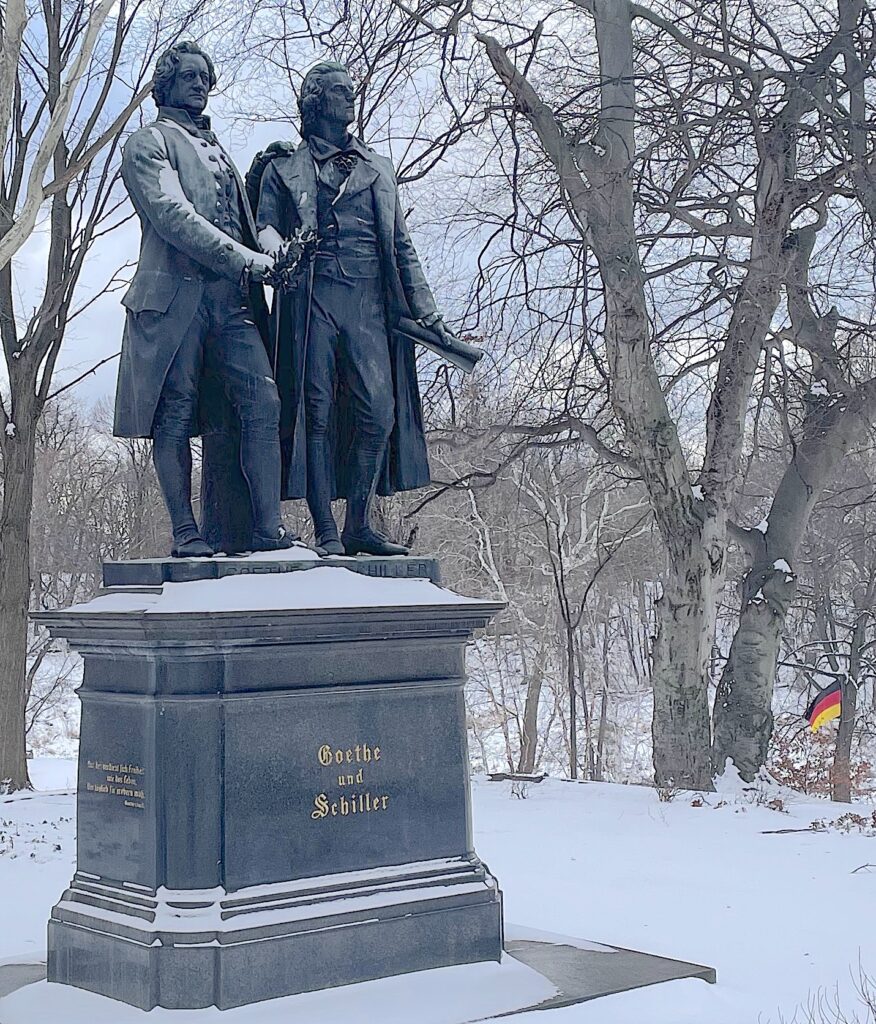 The German Cultural Garden was dedicated in 1929 and was the third garden added to the Cleveland Cultural Gardens. Germans formed one of Cleveland’s largest cultural groups in the late 19th and 20th centuries, and today many of the families who support the garden have ancestors from German-speaking countries near modern Germany.
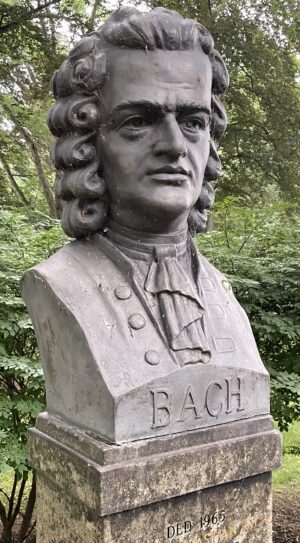
The garden’s upper level features a 1937 metal archway, designed by artists Herman Dercum and Carl Broeml and honoring artist Albrecht Duerer (1471-1528); composer Johann Sebastian Bach (1685-1750); and writer Ulrich von Hutten (1428-1523). At the center of the garden is the statue of Johann Wolfgang Goethe and Friedrich von Schiller. Goethe is considered the most influential writer in the German language, prominent in the fields of literature, politics and philosophy. Schiller was Germany’s leading classical playwright. Schiller and Goethe were contemporaries and together founded the Weimar theater. Their monument is a replica of a statue in Weimar Germany.
Statuary/Busts/Reliefs/Monuments:
Goethe and Schiller: world renown philosophers and writers. The Goethe -Schiller bronze statue was dedicated in 1907 at Wade Park and rededicated 1927 at 1036 East Boulevard. It was designed by artist Ernst Rietschelcast in 1857, and the design used again for the Cleveland statue.
Father Friedrich Jahn: founder of calisthenics exercises and designer of gymnastic equipment such as the horse, rings, parallel bars and balance beam. Cleveland was the third U.S. city to introduce gymnastics to the public, in 1850.
Johann Sebastian Bach: composer.
Alexander von Humboldt: described as the “last universal scholar in the field of natural sciences.” His pioneering work led to meteorological monitoring and other modern science.
Heinrich Heine: poet.
Ludwig van Beethoven:, composer.